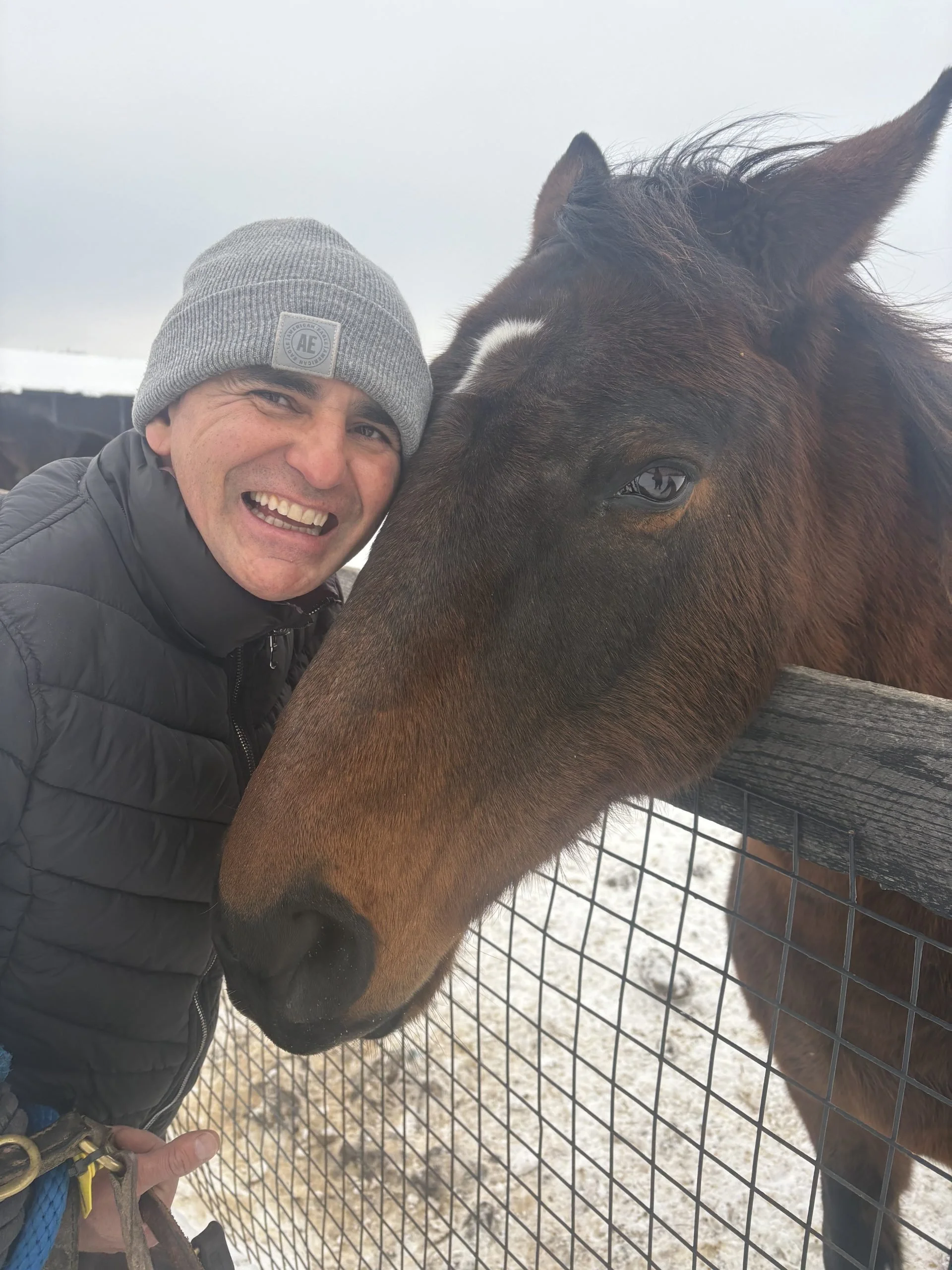
Human-ship: What the Horse Teaches Us About Ourselves
To be with a horse in this way is not about horsemanship — it’s about human-ship.
It’s about meeting yourself in the presence of a being that sees without judgment and connects without condition.
In the equestrian world, we talk a lot about control, technique, and mastery. We train, we lead, we ride. And yes — skill matters. But there’s another kind of relationship with the horse, one that begins not with a lead rope or saddle, but with presence. With humility. With truth.
This is not about “what to do with the horse.”
It’s about who you become in front of it.
The Horse Doesn’t Care About Your Story
The horse doesn’t care about your title, your past, your opinions, your résumé.
It doesn’t care what you’ve accomplished or what you’re ashamed of. It doesn’t need you to be impressive — just real.
That’s the quiet power of the horse: it responds to what’s beneath the surface. If you come anxious but pretending to be calm, the horse will feel the dissonance. If you show up nervous but honest, the horse often relaxes — because you’re congruent. You’re not hiding.
In this way, the horse becomes a kind of truth-teller — not with words, but with presence.
Connection Without Condition
Most of us are used to relationships built on conditions. We are loved if we succeed, accepted if we fit in, heard if we say the right thing.
The horse doesn’t play by those rules. Its connection is simple and powerful:
If you’re present, it feels you. If you’re grounded, it trusts you. If you’re honest, it opens to you.
That kind of connection is rare in the human world.
And yet, once you feel it — even for a moment — something shifts.
You begin to understand that you don’t have to perform to be worthy of connection.
You just have to show up as you are.
The Horse Sees You — The Real You
Many people say, “I feel seen” after being with a horse. But it’s not the kind of “seen” that comes from someone analyzing you or validating you. It’s deeper. It’s energetic.
The horse sees the parts of you that are tender, unsure, still healing. And instead of turning away, it simply stays. Or walks beside you. Or places its nose near your heart without needing anything in return.
That moment — no matter how small — can change you.
Because once you’ve been seen like that, without judgment, it becomes harder to keep judging yourself.
Human-ship: A Different Kind of Leadership
In traditional horsemanship, leadership often meant dominance — being in charge, showing who’s boss. But the kind of leadership the horse truly responds to is quiet leadership: rooted in clarity, calm, and connection.
And this is where the horse teaches us about being human.
It’s not about forcing trust. It’s about earning it by being trustworthy.
It’s not about controlling others. It’s about regulating yourself.
It’s not about being perfect. It’s about being present.
Human-ship, then, is the art of being with another being — horse or human — in a way that honors their dignity, their rhythm, and their truth.
In the Eyes of the Horse, You Might Finally Meet Yourself
There’s a moment that happens sometimes in the field:
The horse stands still. You breathe.
Time slows down.
And in that stillness, you feel yourself — not the busy mind, not the expectations, not the masks — but the deeper self that rarely gets space to speak.
In that moment, you’re not alone.
You’re witnessed — by a being who doesn’t need you to change, fix, or impress.
And maybe, just maybe, that’s where healing begins.
Final Thoughts: The Sacred Mirror
To walk beside a horse with this kind of awareness is to walk beside a sacred mirror. One that doesn’t flatter or distort — but reflects you back to yourself with honesty and compassion.
This isn’t horsemanship.
It’s human-ship.
And we need more of it in the world.