
Jungian Mirrors in Motion - Thoughts On How Horses Partner with Us On the Path of Individuation
Carl Jung, the Swiss psychiatrist and founder of analytical psychology, devoted his work to understanding the deeper layers of the human psyche—those parts of us that lie beneath conscious awareness. He spoke of the unconscious not as something separate from life, but as an active, living force that communicates through symbols, dreams, projections, and patterns of behavior. In Jungian work, growth is not about becoming someone else, but about becoming more fully oneself through a process he called individuation - the ongoing integration of the conscious and unconscious aspects of the psyche.
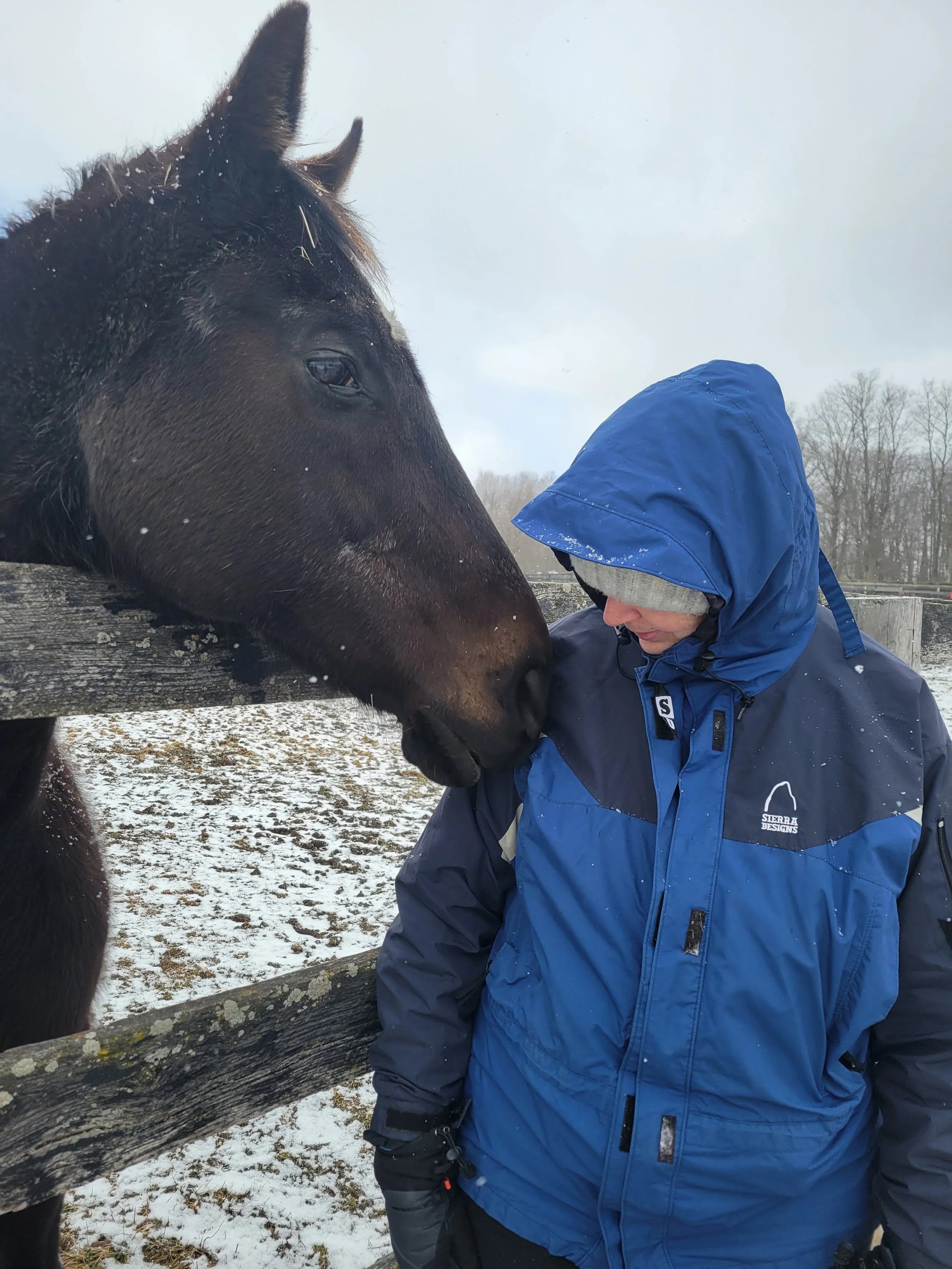
Working with horses in an equine learning context can serve as both a direct, embodied entry point into this process and something that unfolds alongside it. Horses are highly attuned, sensitive beings who respond not only to physical cues, but to emotional states, intention, and internal coherence. In this way, horses become partners in a dialogue with the unconscious. They reflect back aspects of ourselves that are often difficult to see directly, making them powerful allies in psychological and emotional development.
There’s a moment that happens in equine learning - quiet, almost imperceptible - where the dynamic shifts. One might enter the arena with a sense of direction, intending to guide or influence the horse. Yet, as the interaction unfolds, the roles begin to reverse. The horse responds not to words alone, but to presence, clarity, and internal state. In that moment, the human becomes the one who is being met, read, and reflected. This shift echoes what can be understood through Jungian concepts such as enantiodromia - the principle that psychological processes tend to move toward their opposite. What appears as leadership can become listening. What appears as control can become surrender to awareness.
Within this relational field, projection becomes visible. Qualities that seem, in the human’s perception, to belong to the horse - resistance, sensitivity, unpredictability - actually mirror aspects of the human psyche that have not yet been consciously owned. Horses offer a non-verbal mirror, revealing where internal incongruence exists. When intention, emotion, and action are not aligned, horses often respond with confusion, distance, or heightened alertness. When there is alignment, a different quality emerges - one of connection, trust, and responsiveness.
This dynamic allows for a direct encounter with the shadow - the parts of the self that are denied, avoided, or unintegrated. The shadow does not appear as an abstract idea in this context, but as a lived experience within the relationship. A sense of frustration, fear, or inadequacy may arise in the presence of a horse, and rather than being dismissed, these responses become material for awareness. In this way, horses help bring the unconscious into form, making it available for reflection and integration.
Equine learning also offers a unique way to work with psychological complexes - emotionally charged patterns that influence perception and behavior. A person may carry a complex around not being seen or valued, and this can show up in the arena as disconnection or overcompensation. Horses respond not to the narrative, but to the underlying state. In doing so, they reveal the pattern in action. This creates an opportunity not just to understand the pattern intellectually, but to engage it directly, moment by moment, in a living system.
Over time, this work invites a deeper kind of presence. The focus shifts from trying to perform correctly, to becoming more internally coherent. Horses respond to this coherence. As awareness deepens, the relationship changes. The horse and the human meet each other in a space that is less about control and more about mutual attunement. What emerges is not mastery over the horse, but a more integrated relationship with the self, reflected through the presence of horses as partners in the process of becoming whole.
