
Joy as a Living State: What Horses Teach Us About Returning to Ourselves
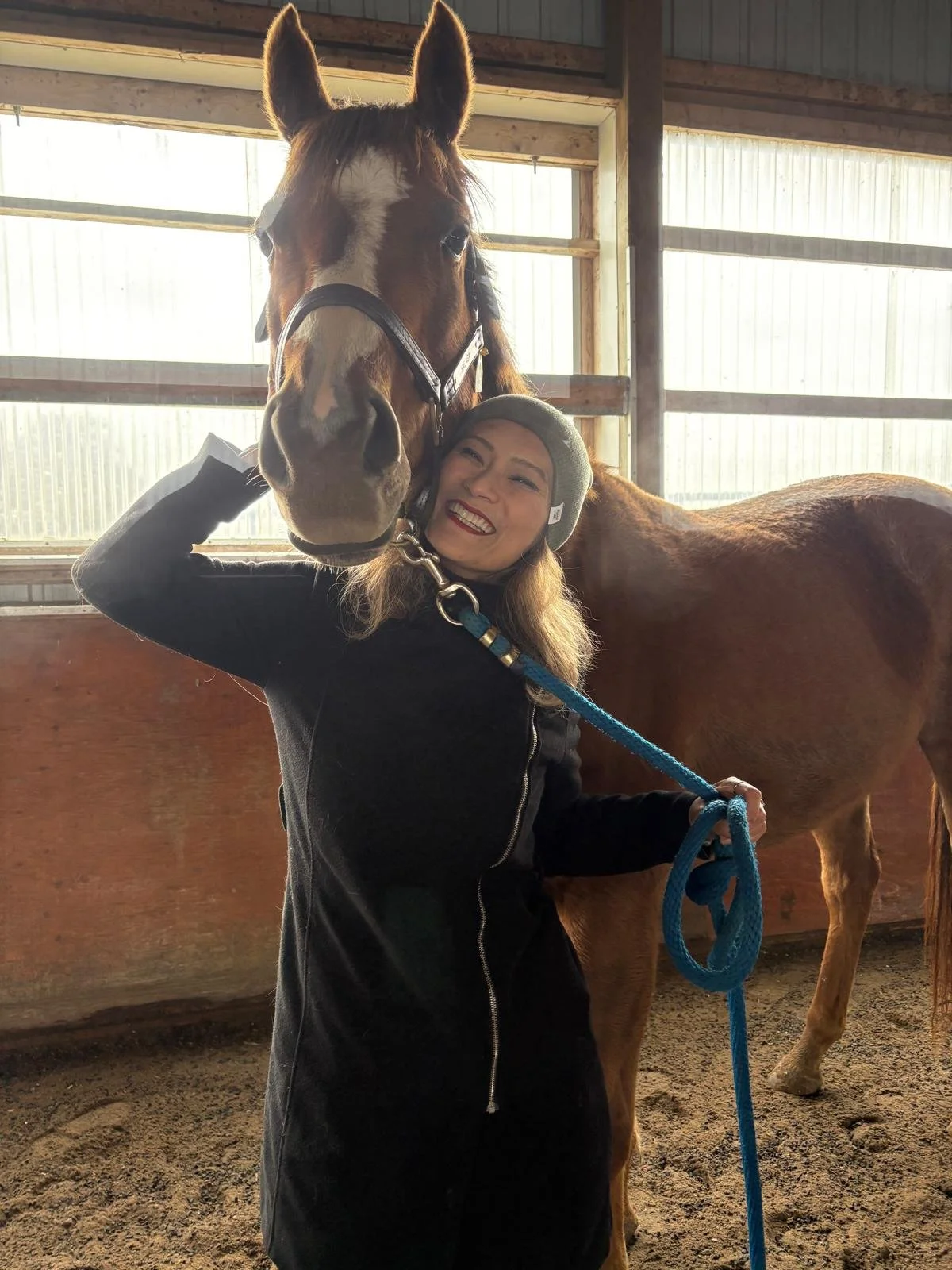
EEC Program’s Harmony with Client Nicole
There’s a kind of joy that isn’t loud, performative, or dependent on circumstances. It doesn’t arrive because everything is finally “figured out.” It’s quieter than that. More honest. It lives underneath the noise of striving and the pressure to be someone we’re not.
This is the kind of joy horses invite us back into. Not by teaching it in words - but by embodying it.
Joy Beyond Happiness
In Western culture, joy is often confused with happiness - something we achieve, chase, or earn. But from a depth psychological perspective, especially through the work of Carl Jung, joy is not a surface emotion. It’s a byproduct of alignment.
Jung understood that much of human suffering comes from fragmentation - parts of ourselves split off, denied, or pushed into the unconscious. The process of individuation - becoming who we truly are - requires meeting those hidden aspects and integrating them.
And something remarkable happens when we do. We don’t just become more “whole.” We become more alive.
Joy, in this sense, isn’t something we chase - it’s something that emerges when we stop abandoning ourselves.
Horses as Mirrors of the Unconscious
Horses meet us at this exact threshold.
They don’t respond to who we think we are, or who we’re trying to be. They respond to what’s actually present - our nervous system, our emotional state, our authenticity (or lack of it).
This makes them extraordinary partners in the process Jung described.
Where traditional self-reflection relies on thinking, horses create a living feedback loop.
If we’re disconnected, they feel it
If we’re guarded, they respond to it
If we soften, they soften
If we become congruent, they meet us there
In this way, the arena becomes more than a space - it becomes a field of awareness where unconscious material surfaces naturally. And when that happens, something begins to shift. Not through force. Not through analysis. Through presence.
Eastern Teachings and the Nature of Joy
In Buddhism, joy (often referred to as mudita) arises not from grasping, but from presence and non-attachment. It’s what remains when we’re no longer resisting what is.
Similarly, in Taoism, there is an emphasis on wu wei - effortless action, or being in flow with life rather than against it. Joy here is not something we manufacture, but something that naturally arises when we are in harmony with ourselves and our environment.
Horses live in this state. They are not striving to become anything. They are fully in their experience - attuned, responsive, and present. And when we step into their world, they invite us to do the same.
The Nervous System and the Biology of Joy
There is also a physiological dimension to this. When we are in the presence of horses, our nervous systems begin to regulate. Their large, coherent heart rhythms and grounded presence can influence our own biological state. Research shows:
Increased oxytocin (connection and bonding)
Increased dopamine and serotonin (pleasure and mood regulation)
Decreased cortisol (stress hormone)
But beyond the chemistry, there is something more subtle happening. We begin to feel safe enough to be real. And joy cannot exist without that safety.
Joy Through Connection: The EEC Experience
At the Equine Experiential Connection (EEC) Program, this is the heart of the work.
Through FEEL® (Facilitated Equine Experiential Learning), participants engage in specially designed, ground-based activities with horses.
In these interactions:
Horses reflect your internal state in real time
Patterns become visible without needing explanation
Emotional awareness deepens naturally
Authentic confidence begins to emerge
And often - unexpectedly - so does joy.
Not the kind that comes from “getting it right,” but the kind that arises when you finally feel:
Seen
Regulated
Connected
Whole, even for a moment
Joy as a Byproduct of Truth
One of the quiet truths that emerges in this work is this: joy is not something we need to add to our lives. It’s something that appears when we stop distorting ourselves.
When we stop performing.
When we stop overriding what we feel.
Horses don’t ask us to be better - they ask us to be real. And in that space - where nothing extra is required - joy has room to surface.
A Return, Not a Discovery
Many people come to this work searching for clarity, healing, or direction. And they find those things. But what often surprises them is the return of something they didn’t realize they’d lost. A sense of lightness. A sense of ease. A sense of being in life, rather than managing it. Joy.
Not as a peak experience - but as a quiet, steady undercurrent.
Something that was always there, waiting beneath the noise.
