
When a Horse Lies Down: A Quiet Invitation Into Vulnerability
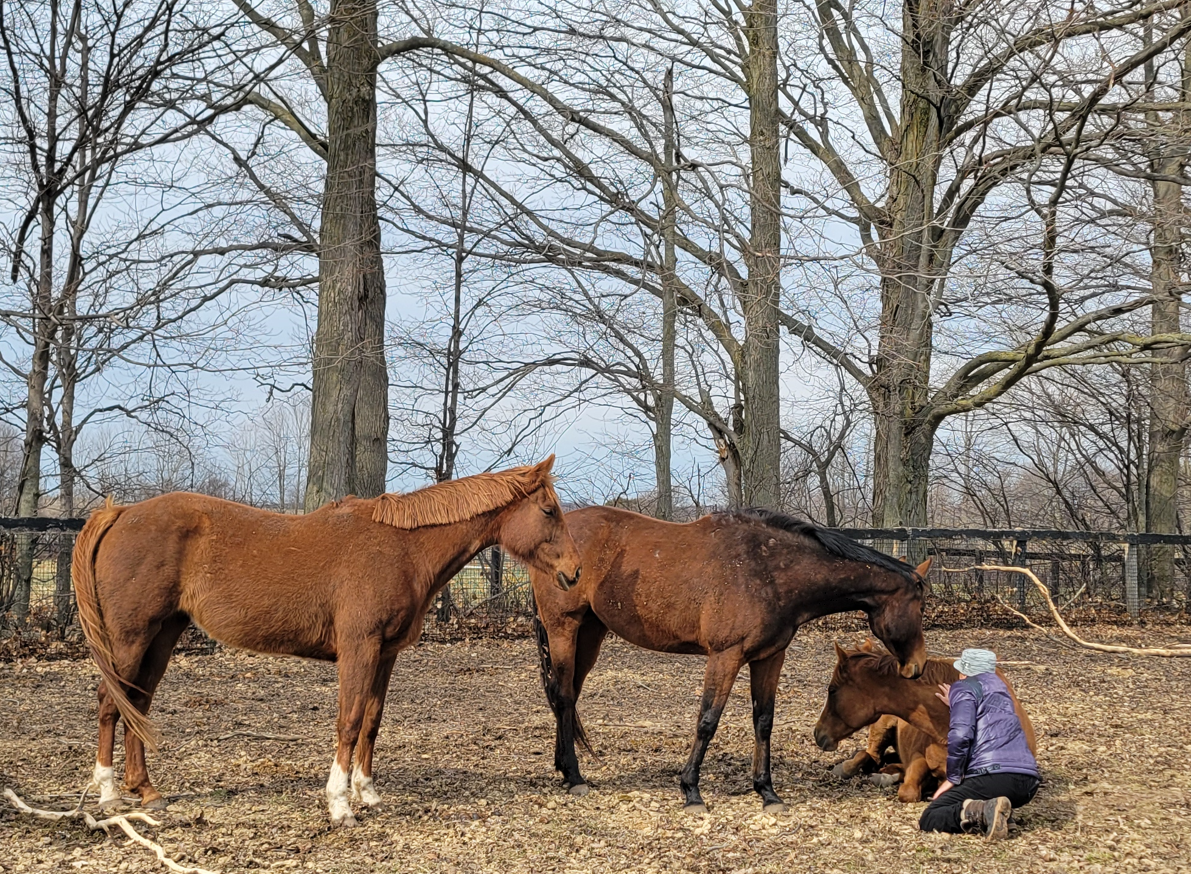
Harmony lying down with Eurico, with Hygge (right) and Maggie (left) nearby
When a horse lies down or rolls during our work with a client, it is a very special and profound occurrence. A horse lying down is an invitation into deeper vulnerability, because for a horse, lying down means less capacity to flee, symbolizing trust, openness and safety.
Vulnerability begins with whether you’re willing to meet yourself deeply and actually feel what’s true for you.
There’s a moment that we tend to be able to sense where something real starts to surface internally - a discomfort, a knowing, a tension - and instead of entering it, there’s a subtle shift away. You think about it rather than feel it, organize it rather than experience it, staying close enough to remain aware but not close enough to be changed by it. Not because you’re avoiding growth, but because genuine contact with the inner world asks you to release control in a way that isn’t always comfortable.
From a Jungian perspective, that edge matters. Carl Jung wrote extensively about the shadow - the aspects of the psyche that remain outside of conscious identification, not because they are unimportant, but because they are often charged, unfamiliar, or inconvenient to the identity we’ve built. To drop beneath the surface of your own experience is to begin encountering that material directly, not as theory but as lived reality. And while that can feel destabilizing at first, it is also where integration begins - where energy that has been tied up in avoidance starts to return.
This is where vulnerability becomes something far more precise than openness or expression. It becomes the capacity to stay in contact with yourself without immediately reshaping what you find. To feel something without needing to resolve it. To allow truth to exist before deciding what to do with it.
Horses offer a clear, embodied reference point for this kind of presence.
Their sense of safety is not conceptual - it is entirely lived through the body. Because of that, the way a horse rests carries weight. When a horse lies down or rolls, they are not only relaxing; they are entering a state that requires trust. In that position, they cannot respond to the world in the same immediate way. There is a yielding, a relinquishing of readiness, a full-body agreement with the environment they are in.
To witness a horse lying down in your presence is quietly profound. Their body softens completely into the ground, without hesitation or fragmentation. There is no part of them holding back or staying slightly removed. They are fully within the moment, and that level of surrender shifts the entire field around them.
In a session space, that shift can be deeply informative - and transformative.
Horses tend to meet what is real rather than what is presented. When someone stays in a falsely-manufactured managed or controlled state, the horse will mirror the chaos under the surface. And when a person allows themselves to drop into a more honest internal state, even very subtly, the horse feels it fully. There is a movement toward coherence, and the horse often responds with greater presence, softness, or engagement.
At times, when a horse lies down or rolls before a session, it can feel like the space itself is being set in a particular way. Not as a performance, and not as something directed toward a person, but as a reflection of what is possible within that environment. There is enough safety here for a body to let go. And within that, there is an unspoken invitation for the client as well.
To stop organizing the experience from the outside, and instead move closer to what is actually being felt. To let the surface give way, even slightly, to something deeper and more honest.
Jung’s insight that “one does not become enlightened by imagining figures of light, but by making the darkness conscious” points directly to this kind of work. It is not dramatic most of the time. It unfolds in the willingness to remain present with what is uncomfortable, uncertain, or unresolved, without immediately stepping away.
Horses, in their way of being, hold a steady orientation toward deep levels of truth and wholeness. They do not require it, but they respond to it and mirror it back to us.
So when a horse lies down or rolls in the arena, it is more than a beautiful or rare moment. It reflects a level of trust and safety certainly, but it also demonstrates what becomes possible when there is enough safety to release control and fully inhabit the present moment - and it is an invitation for the participant to drop walls, go one level deeper, and really allow themselves to meet themselves from within.
And that is the deeper invitation within this work: not simply to express vulnerability, but to live it internally - to come into contact with your own experience without distancing from it, and to stay long enough for something real to shift.
