
The Wisdom of Horses: How FEEL® and Jungian Psychoanalysis Meet
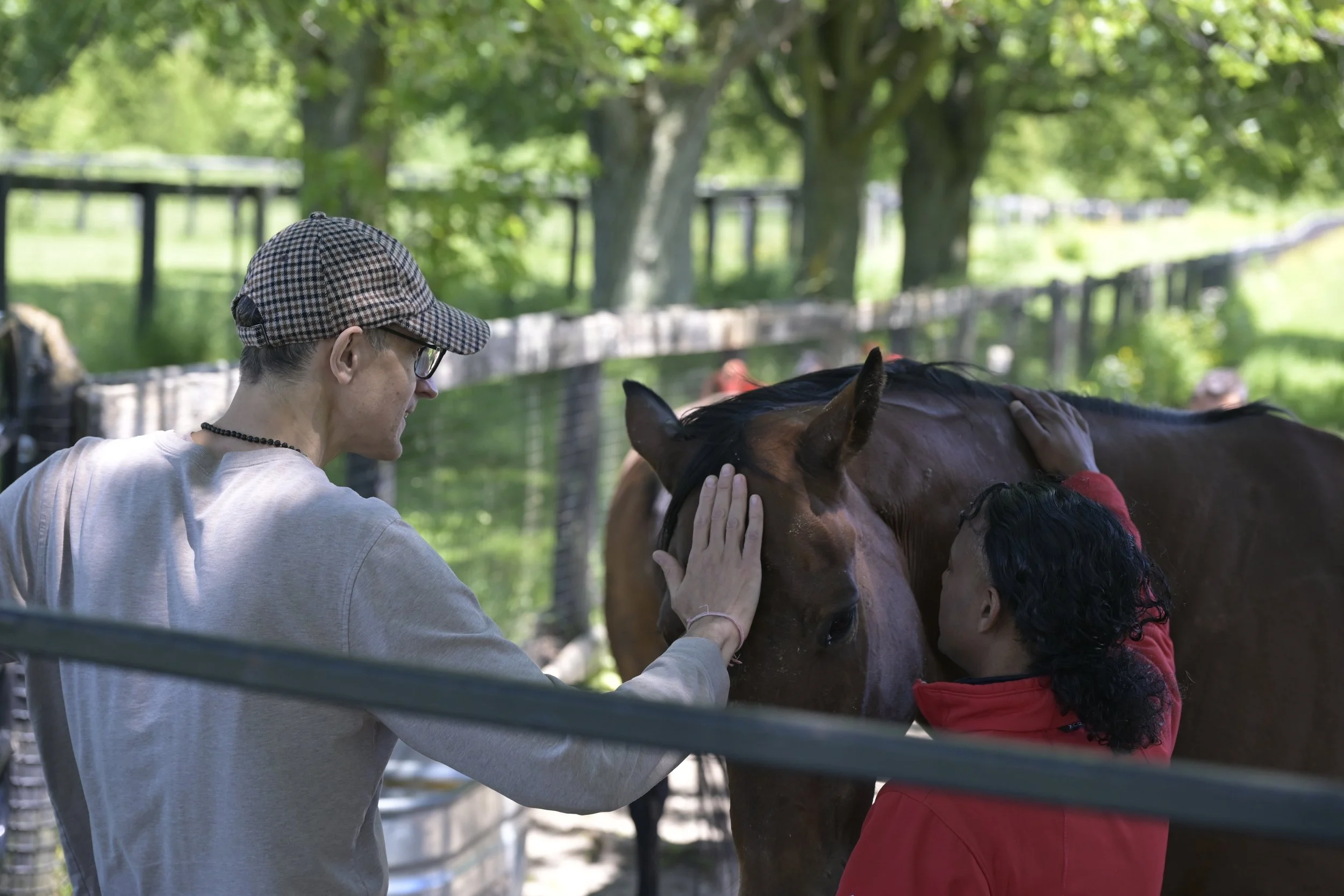
Exploring the unconscious, embodied experience, and the journey toward psychological wholeness.
What if some of our most meaningful psychological insights could emerge not from talking, but from being fully present with another living being?
In Jungian psychoanalysis, the journey toward wholeness involves bringing unconscious patterns, emotions, and disowned aspects of ourselves into consciousness. Through dreams, symbols, and reflection, we begin to recognise the forces shaping our experience and our relationships.
FEEL® (Facilitated Equine Experiential Learning) offers a distinctive experiential perspective on this process. Through guided, ground-based activities with horses, participants encounter situations that can illuminate habitual responses, relational dynamics, and the difference between what we believe about ourselves and what we experience in the moment.
Although FEEL® and Jungian psychoanalysis are distinct approaches, both invite us to look beyond our conscious narratives and become curious about the deeper patterns influencing how we relate to ourselves and the world.
The Horse as Mirror
As prey animals, horses are highly attentive to their surroundings and responsive to movement, body language, tension, and changes in behaviour. Their sensitivity makes interactions with them a compelling setting for exploring human responses and relational patterns.
A horse may appear intimidating, disinterested, welcoming, unpredictable, or comforting to us. Our interpretations can reveal something about our expectations, emotional associations, and habitual ways of making sense of the world. A horse stepping away, for example, might evoke rejection in one person and freedom in another. One participant may feel compelled to regain the horse’s attention, while another discovers the possibility of allowing the interaction to unfold without trying to control it.
In Jungian psychology, projection describes the process through which aspects of our inner experience are attributed to someone or something outside ourselves. An encounter with a horse can bring this process into focus, inviting us to consider how our perceptions are shaped by our own psychological history.
Through facilitated activities, we can examine our responses as they arise. Do we approach with confidence or hesitation? Do we seek approval, withdraw when uncertain, or accommodate another at the expense of our own needs? What happens when the horse does not respond as we expect?
The horse is not a diagnostic tool, and its behaviour cannot establish what is happening in our unconscious. Rather, the encounter provides an opportunity to distinguish between what the horse actually does, how we interpret it, and what that interpretation might reveal about us. With thoughtful facilitation, an ordinary interaction can become a meaningful starting point for psychological inquiry.
Meeting the Shadow
Jung’s concept of the shadow encompasses aspects of ourselves that remain unrecognised, rejected, or excluded from our conscious identity. These may include difficult emotions and impulses, but also positive qualities we have learned to suppress, such as assertiveness, ambition, vulnerability, or the freedom to express our needs.
We may understand intellectually that we struggle with boundaries or seek approval, yet continue to enact these patterns without recognising them as they unfold.
Working with horses can bring such tendencies into immediate experience. We might notice an urge to please, frustration when an interaction does not go our way, discomfort with taking up space, or reluctance to communicate clearly. We might equally encounter unexpected confidence, patience, or willingness to assert ourselves.
The significance lies not in labelling a response as good or bad, but in examining it. What does this reaction protect us from? What assumptions underpin it? How might a pattern that once served an important purpose now limit our choices?
From a Jungian perspective, integrating the shadow involves developing a more conscious relationship with these disowned aspects of the personality. An embodied encounter can provide material for that process, making familiar tendencies visible in a new context.
From the Mind into the Body
Psychological understanding is often associated with thought and analysis. Yet not all our responses are immediately available to conscious reflection. We may hold our breath when uncertain, tense under pressure, or instinctively attempt to manage another’s response rather than attend to our own needs.
FEEL® places participants in direct, embodied encounters in which presence, communication, and boundaries become practical concerns rather than abstract concepts. There is no riding or prescribed outcome. Instead, participants engage in carefully facilitated activities with horses, observing how they respond to uncertainty, connection, and the possibility of losing control.
Can we remain present when an outcome is unclear? Can we approach without forcing? Can we respect another’s boundaries without abandoning our own?
These questions have relevance beyond the horse-human relationship. They touch on the ways we navigate intimacy, conflict, leadership, and responsibility in everyday life.
Research into human-horse interactions suggests that appropriately facilitated equine-assisted activities may support emotional regulation, reduce perceived stress, and contribute to aspects of well-being. The experience of working alongside a horse can also draw attention to bodily cues and emotional responses that might otherwise go unnoticed.
Embodied awareness does not replace psychological understanding. Rather, it adds another dimension to it: the opportunity to experience a response, reflect on its meaning, and consider how we might act differently.
Individuation: Toward a More Integrated Self
Jung described individuation as the lifelong process through which we become more fully ourselves by bringing unconscious aspects of the personality into a more conscious relationship with the whole. It is not a pursuit of perfection, but a gradual movement toward greater psychological integration.
This process involves recognising the tensions that shape our lives: control and trust, independence and connection, assertiveness and receptivity. Individuation asks us to hold such opposites in awareness rather than resolving them through rigid identification with one side.
The horse-human relationship can provide a tangible setting in which to encounter these tensions. We may discover that confidence has become forcefulness, that accommodation has replaced genuine receptivity, or that the desire for connection has led us to disregard our own boundaries.
Such encounters do not automatically resolve longstanding psychological conflicts. Their value lies in what they make available for further consideration: a familiar pattern seen from a different perspective, a previously excluded quality brought into awareness, or a new possibility for responding.
In this sense, FEEL® and Jungian psychoanalysis can be understood as complementary in their interest in the relationship between conscious understanding and lived experience, while remaining distinct in their methods, aims, and professional frameworks. FEEL® is not a substitute for psychotherapy or psychoanalysis; its contribution is experiential rather than interpretive or clinical.
Conclusion
The wisdom of horses lies not in their ability to reveal hidden truths about us, but in the encounters they make possible. Their responses give us something immediate to engage with, while our interpretations offer a window into the assumptions, emotions, and relational habits through which we experience the world.
Viewed through a Jungian lens, these encounters can become opportunities to examine projection, recognise shadow material, and explore the tensions involved in becoming more psychologically integrated.
Sometimes, the movement toward greater consciousness begins when an experience interrupts what we have taken for granted. In the presence of a horse, we may find ourselves confronting not simply how we behave, but why we respond as we do—and what new possibilities emerge when those responses become available to conscious choice.
About the Author: Alexandra is an Advanced FEEL® Facilitator who specializes in horse work through a Jungian - depth psychoanalytical - and shamanic lens. She is currently in the process of qualifying to become a Jungian Analyst and Psychotherapist.
